Europass CV: what it is, when to use it and a free alternative
A Europass CV is a standard CV format from the European Union's free Europass platform, used mainly for EU institutions, Erasmus+ and some public-sector and university applications. Use the official tool when you are asked for Europass; for most other jobs a clear, shorter Europass-style CV works just as well.
- 100% free PDF download
- Free account to download
- No watermark
Last updated
Need an official Europass CV?
If an employer, university or EU body asks for a Europass CV, use the official, free Europass editor run by the European Commission. CompleteCV is not affiliated with Europass or the European Union.
Go to europass.europa.euWhat Europass is
Europass is a free online service from the European Commission for people who study or work in Europe. It started as a set of standard document formats, and since its relaunch in 2020 it has been a full platform. According to the official site, it includes:
- A personal profile where you store your education, jobs, skills and qualifications once.
- A CV editor that turns your profile into a CV, in 31 languages, with a choice of designs.
- A cover letter editor in the same style.
- European Digital Credentials for Learning, a way for schools and training bodies to issue diplomas and certificates digitally so they can be checked.
- Supporting documents such as the Diploma Supplement, Certificate Supplement and Europass Mobility record, which are issued by institutions rather than written by you.
The CV is the part most people mean when they say "Europass". Its goal is comparability: every Europass CV has the same sections in the same order, so a recruiter in Lisbon can read a CV from Warsaw without hunting for anything. That is its strength and also its weakness, as we will see.
When you should use a Europass CV
Use the official Europass format when someone asks for it. The most common cases are:
- EU institutions and agencies. Some vacancy notices and traineeship schemes ask for a Europass CV or a CV in a similar structured format. Read the notice carefully.
- Public-sector jobs in some EU countries. Some ministries, local authorities and public universities name Europass as the expected format. The job ad will say so.
- Erasmus+ and other exchange programmes. Application packs for study and work placements abroad often ask for one.
- University admissions, especially master's programmes, where the applications office asks for a "European format CV".
- EU-funded projects and tenders, where team members' CVs are often attached in a fixed format.
If the ad does not mention Europass, you do not need it. Most private employers across Europe, from start-ups in Berlin to banks in Dublin, prefer a concise CV that puts your strongest experience first. Because so many CVs share the Europass design, an unrequested one can make you blend in rather than stand out.
| Question | Official Europass CV | Europass-style or modern CV |
|---|---|---|
| Who makes it | You, in the free Europass editor run by the European Commission | You, in any editor or CV builder |
| Layout | Fixed sections; a few designs to pick from | Any clean layout, one or two columns |
| Length | Often runs to three pages or more if you fill every section | Usually one or two pages |
| Languages | CEFR self-assessment for five skills per language | One CEFR level per language is usually enough |
| Best for | EU institutions, some public bodies, Erasmus+ and some university applications | Most private-sector jobs in Europe and beyond |
| Recruiter view | Familiar and easy to compare, but can look generic | Easier to make your strongest points stand out |
Pros and cons, honestly
What Europass does well:
- It is free, available in 31 languages and recognised across Europe.
- The structure stops you forgetting important information, such as language levels or digital skills.
- Your profile is stored, so you can produce new CVs without retyping everything.
- Reviewers who handle hundreds of applications in the same format can compare them quickly.
Where it falls short:
- Because the editor offers many sections, CVs often grow to three or four pages full of thin entries.
- The layout is the same for everyone, so it is harder to stand out on design or emphasis.
- Rating five language skills per language takes a lot of space for people who speak several languages.
- It nudges you towards listing duties and personal details rather than results.
The fix for most of these is editing, not a different tool. Even in the official editor you can leave sections out, write short entries and lead with achievements.
The Europass CV layout
A Europass CV reads top to bottom in a single column. Personal details and an optional photo come first, followed by a short "About me", then work experience and education in reverse date order, then skills. The diagram on the left shows the typical order. The one on the right shows a shorter Europass-style CV that keeps the same reading order but trims it to what a recruiter needs.
Typical Europass CV order
Europass-style CV, two A4 pages
How to fill in each section
Personal information
Give your name, phone number with country code, a professional email address and your city and country. A LinkedIn URL helps. Europass offers fields for nationality, date of birth and gender. Add nationality if your right to work matters for the role (for example, you are an EU citizen applying in another EU country). Add date of birth and gender only if the application asks for them. Many employers, especially in the UK, Ireland and the Netherlands, prefer not to see them.
About me
Three or four sentences. Say what you do, your level and what you want next, with one concrete achievement. For example: "Logistics coordinator with six years in cross-border road freight between Poland and Germany. Cut customs delays on my routes by moving paperwork to a shared checklist. Looking for a planning role in a Dutch or German 3PL." Avoid long lists of adjectives such as "hard-working, motivated team player".
Work experience
List jobs from newest to oldest with dates, employer, city and country. Under each job, write two to five bullet points. Start each with a verb and show what changed because of you: "Trained 12 new warehouse staff on the scanner system" is stronger than "Responsible for training". Older or unrelated jobs can be one line each.
Education and training
Give the qualification, the institution, the city and the dates. Because grading systems differ across Europe, add context when it helps: "Laurea Magistrale in Economics, 110/110" means a lot in Italy but may need "(top mark)" elsewhere. Add your thesis title if it relates to the job. Short courses and certificates can go here or in a separate section.
Language skills
Give your mother tongue, then each other language with its CEFR level. The official Europass editor uses the CEFR self-assessment grid, where you rate listening, reading, spoken interaction, spoken production and writing separately. Be honest: interviews in Europe often switch language without warning. If you have a certificate such as DELF, Goethe-Zertifikat, DELE or IELTS, name it with the level.
Digital skills
Name the tools you actually use at work: "Excel (pivot tables, XLOOKUP), SAP MM, Power BI, Jira". Vague phrases such as "good computer skills" tell the reader nothing. Group them if the list is long.
Other sections
Driving licence (with category, for example "B"), volunteering, publications, projects and hobbies are optional. Include them only when they support your application. A driving licence matters for field sales or logistics; a hobby rarely matters unless it shows a relevant skill.
CEFR language levels explained
The Common European Framework of Reference for Languages, from the Council of Europe, describes language ability in six levels. Employers across Europe know it, so it is worth using on any CV for a European job, Europass or not. The descriptions below are short summaries in our own words.
| Level | Name | You can usually | On a CV |
|---|---|---|---|
| A1 | Breakthrough | Understand and use familiar everyday phrases; introduce yourself. | Rarely worth listing unless the job values any exposure to the language. |
| A2 | Waystage | Handle simple, routine exchanges about familiar topics. | List it for customer-facing or travel roles where basic courtesy helps. |
| B1 | Threshold | Deal with most everyday situations and describe experiences. | A working level for many jobs that use the language now and then. |
| B2 | Vantage | Talk with native speakers fairly fluently; understand complex texts on familiar subjects. | Often the minimum for jobs where you work in that language. |
| C1 | Effective operational proficiency | Use the language flexibly at work and in study; write clear, detailed text. | Professional fluency. Typical for client work or university study in that language. |
| C2 | Mastery | Understand virtually everything and express yourself precisely. | Near-native. Use it for your mother tongue alternative only if it is true. |
If your levels differ by skill, say so simply: "German: C1 reading, B2 speaking". That is honest and still short.
A free Europass-style CV with CompleteCV
If you like the clear, single-column order of Europass but want a CV that looks less generic, use a Europass-style template. Europass-style means the same reading order (personal details, profile, experience, education, languages, skills) without the official branding or fixed design. These two free CompleteCV templates fit well:
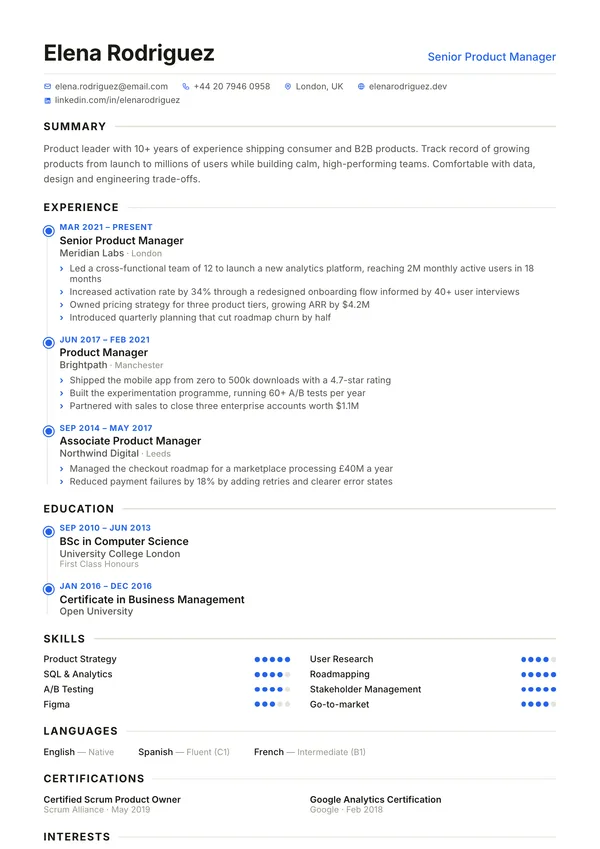
Meridian
Single column with a dated timeline and an optional photo. The closest match to the Europass reading order.
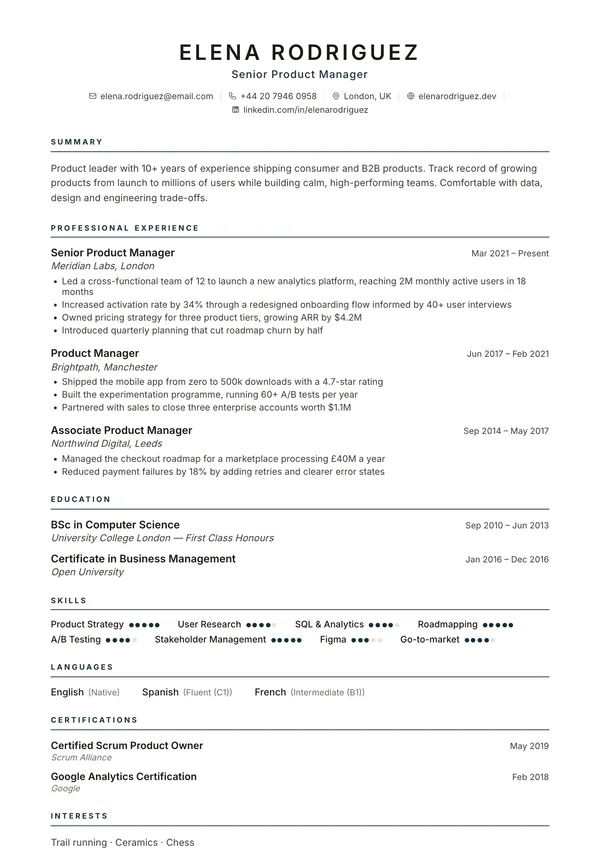
Atlas
Classic single column with a centred header. Choose it when you want a plainer look, with or without a photo.
To build one:
- Open the builder with Meridian (or pick Atlas from the template list).
- Fill in your personal details. Add a photo, nationality or driving licence only if the job or country expects them; they are optional fields you can hide at any time.
- Add the Languages section and write the CEFR level next to each language, for example "French: B2".
- If you apply in another language, switch the section headings to French, German, Spanish, Italian, Portuguese, Dutch, Polish or another language in the Customize tab. You still write the content yourself.
- Check your CV in the Review tab, then download a free PDF. No watermark; download with a free account.
Remember: a Europass-style CV is not a Europass CV. If an application specifically asks for Europass, use the official Europass editor.
Common mistakes to avoid
- Filling every box. An empty-looking "Communication skills: good" adds length, not value. Delete it.
- Copying job descriptions. Write what you achieved, not what your contract said.
- Overrating languages. Claiming C1 and then struggling in a phone interview costs more than an honest B2.
- Old personal details. Marital status, number of children or ID numbers do not belong on a modern CV unless the form asks.
- One CV for every job. Reorder bullets and edit your "About me" for each application.
This is general information about common hiring practice, not legal advice. Always follow the job ad.
Frequently asked questions
Is CompleteCV the official Europass CV maker?
No. CompleteCV is not affiliated with Europass or the European Union. The official Europass CV editor is free at europass.europa.eu. CompleteCV offers free Europass-style templates for people who want a similar single-column structure with a more modern design.
Is the Europass CV free?
Yes. Europass is a free service of the European Commission. You can create a Europass profile and CV without paying anything.
Do employers in Europe still want a Europass CV?
Most private employers do not ask for one and are happy with any clear, well-organised CV. Europass is more common for EU institutions, some public bodies, Erasmus+ applications and some university admissions. Follow the job ad or application instructions.
How do I describe my language level on a Europass CV?
Use the Common European Framework of Reference for Languages (CEFR), from A1 (beginner) to C2 (mastery). The Europass editor asks you to rate listening, reading, spoken production, spoken interaction and writing separately. On a shorter CV, one overall level per language is usually enough.
Should a Europass CV include a photo?
It is optional. A photo is still common in some countries, such as Germany, Austria and parts of Eastern and Southern Europe, and unusual in others, such as the UK, Ireland and the Netherlands. If the employer does not ask for one and local practice is not to include it, leave it out.
How long should a Europass CV be?
There is no fixed length, but two pages is a sensible target for most people. Leave out empty or weak sections rather than filling every box the editor offers.
Can I make a Europass-style CV with CompleteCV for free?
Yes. Pick a single-column template such as Meridian or Atlas, add a photo if you want one, set your language levels and download a free PDF. There is no watermark, and you just need a free account to download.
Keep going
- CV format guide Layout, length and personal details by country.
- CV vs resume Which document to send, country by country.
- Free CV maker Templates for UK, European, African and Indian CVs.
- Free CV templates Preview every template before you start.
- Start a Europass-style CV Opens the builder with Meridian. No sign-up to start.