CV format: how to lay out a CV for the UK, Europe, Africa and India
The standard CV format is reverse-chronological: your name and contact details, a short profile, work experience (most recent first), education, then skills and extras, on one or two A4 pages. What changes by country is the length, the personal details you include and whether you add a photo.
- 100% free PDF download
- Free account to download
- No watermark
Last updated
A4, one or two pages
The standard CV format, section by section
Almost every CV outside North America follows the same skeleton. Recruiters read it top to bottom and expect to find the same things in the same places. If you put your education above ten years of work experience, or bury your phone number at the bottom of page two, you make them work harder than they want to.
A4, one or two pages
A4, photo where expected
Here is the order that works for most experienced candidates, and what goes in each part.
- Name and contact details. Your full name as the largest text on the page, then a phone number, a professional email address, your town or city and, if you have one, a LinkedIn profile or portfolio link. A full home address is no longer needed in most countries. A town and postcode area is enough.
- Personal profile. Three to five lines that say who you are, what you are good at and what job you want. In the UK this is often called a personal statement; in Africa and India it is often called a career objective. Mention the job title you are applying for and one specific strength.
- Work experience. Most recent job first. For each role give the job title, employer, location and dates (month and year), then three to six bullet points that show results rather than duties. Older or less relevant roles can shrink to a single line.
- Education. Degree or qualification, institution and dates. Add grades if they help you (a 2:1, a distinction, a CGPA above the usual cut-off). Once you have a few years of work behind you, drop school results.
- Skills. Six to twelve skills that match the job ad. Group them if you have many (for example "Software", "Languages", "Methods").
- Extras. Certifications, languages, professional memberships, volunteering, publications or projects. Only include what supports the application.
- References. Optional in the UK and Ireland, often expected in Africa. More on this in the table below.
Reverse-chronological, skills-based or hybrid?
You may have read about other formats. A skills-based (or functional) CV groups your experience under skill headings instead of jobs. It can help career changers and people with gaps, but many recruiters distrust it because it hides when and where you did things. A hybrid CV puts a short "key skills" block at the top and keeps a normal job history underneath. If you are unsure, use reverse-chronological. If you are changing career, use the hybrid, not a pure skills-based CV. Our resume format guide covers these three formats in more detail.
CV length, paper size and layout
Outside the US and Canada, CVs are printed and viewed on A4 paper (210 × 297 mm). Even if nobody prints your CV, recruiters often view it as a page, so a page that is the wrong shape or spills a few lines onto a third sheet looks careless.
| Your situation | Usual length | Notes |
|---|---|---|
| Student, school leaver or fresher | 1 page | Fill one page well rather than stretching to two. |
| 2 to 10 years of experience | 1 to 2 pages | Two full pages is normal in the UK and Ireland. |
| Senior or specialist roles | 2 pages (3 in some markets) | Summarise roles older than 10 to 15 years. |
| Academic, medical or research posts | No fixed limit | Publications, grants and teaching can run to many pages. |
Fonts, margins and spacing
- One or two fonts at most. A clean sans-serif (Arial, Calibri, Helvetica, Lato and similar) or a readable serif (Georgia, Garamond) for academic and legal roles.
- Body text at 10 to 12 points, section headings at 12 to 14 points, your name at 14 to 18 points or larger.
- Margins of about 1.5 to 2.5 cm. Squeezing the margins to fit more in makes the page harder to read. Cut words instead.
- Consistent dates. Pick one style, such as "Mar 2022 to Present" or "03/2022 – Present", and use it everywhere.
- Bullet points for achievements, short paragraphs only for the profile.
- No tables of text inside tables, text boxes or text in images. Some applicant tracking systems skip them. The CompleteCV templates are built from real text, so your PDF stays readable by software.
Personal details, photos and references by region
This is where CV formats differ most. A date of birth that is normal in Abuja can look odd in Dublin, and a photo that is expected in Vienna is usually unwelcome in London. The table shows common practice. It is a guide, not a rule book: if the job ad asks for something, include it.
| Region | Photo | Date of birth | Nationality | Marital status | References | Declaration |
|---|---|---|---|---|---|---|
| UK | No | No | Only right-to-work status if relevant | No | Optional; often left off | No |
| Ireland | No | No | Only work permit status if relevant | No | Optional; two referees sometimes listed | No |
| Germany, Austria, Switzerland | Common, not required | Common, optional | Common, optional | Sometimes | Rarely on the CV | A signed, dated CV is still seen |
| France, Spain, Italy | Mixed; still fairly common | Sometimes | Sometimes | Rarely | Rarely | No (Italy: a data-processing consent line is common) |
| Netherlands, Nordic countries | Usually no | Rarely | Only if relevant | No | On request | No |
| Nigeria, Ghana | Sometimes | Often requested | Often listed; state of origin in Nigeria if asked | Sometimes | Two or three referees expected | Rare |
| Kenya | Sometimes | Sometimes | Often listed | Sometimes | Two or three referees expected | Rare |
| South Africa | Rarely | Sometimes | Citizenship or permit status often listed | Rarely | Referees common | No |
| India | Sometimes | Common | Sometimes | Sometimes | Rarely; "available on request" | Common, especially for freshers |
This is general information, not legal advice. Hiring rules and habits change, and individual employers differ: follow the job ad.
A few region-specific habits worth knowing
- UK and Ireland: leave out anything that reveals age, religion, health or family status. If you need a visa to work, say so plainly in one line ("Eligible to work in the UK: Skilled Worker visa required") rather than leaving recruiters to guess.
- German-speaking countries: a tabular CV (Lebenslauf) with exact month-and-year dates and no unexplained gaps is still the norm. Many employers expect a cover letter and certificates in the same application.
- EU public bodies: some ask specifically for the Europass format. See our Europass CV guide for when that applies.
- Nigeria: recent graduates often list their NYSC status (completed, ongoing or exempted) because many employers ask for it.
- Kenya and South Africa: professional registrations (for example with an engineering or nursing council) belong near the top if the job requires them.
- India: recruiters often expect percentages or CGPA for each level of education, and many freshers end with a one-line declaration that the details are true, followed by place and date.
CV format for freshers and students
If you are a student, a recent graduate or a "fresher" looking for your first job, you do not yet have a work history to lead with, so the standard order works against you. Flip it: put education near the top and give projects and internships the space that experienced candidates give to jobs.
A4, one page
What to put in each part
Career objective: two or three lines naming the role and what you bring. "Final-year electrical engineering student looking for a graduate trainee role in power distribution" beats "Seeking a challenging position".
Education: degree, institution, expected or final grade, and two or three relevant modules.
Projects: what you built or researched, the tools you used and the result.
Make one page count
- Treat projects like jobs. Give each one a title, dates and two or three bullet points: what the problem was, what you did, what happened. A final-year project, a hackathon entry or a society event you organised all count.
- Count internships, placements and part-time work. A weekend job in a shop shows reliability, cash handling and dealing with customers. Say so.
- Show results with numbers where you honestly can. "Organised a careers fair for 300 students with 12 employers" tells the reader more than "Event organisation".
- Keep personal details short. Freshers in India and parts of Africa often fill a third of the page with father's name, hobbies and languages known. Keep only what the employer asks for and use the space for projects.
- Skip the school leaving results once you have a degree, unless the employer asks for them (some Indian and Nigerian graduate schemes do).
The Campus template was designed for this layout: education and projects come first, with room for grades and skill tags. You can open it in the builder and switch to any other template later without retyping.
Recommended CV templates
All CompleteCV templates are free, follow the section order above and download as a PDF with no watermark. Pick by the market you are applying to, not just by looks.
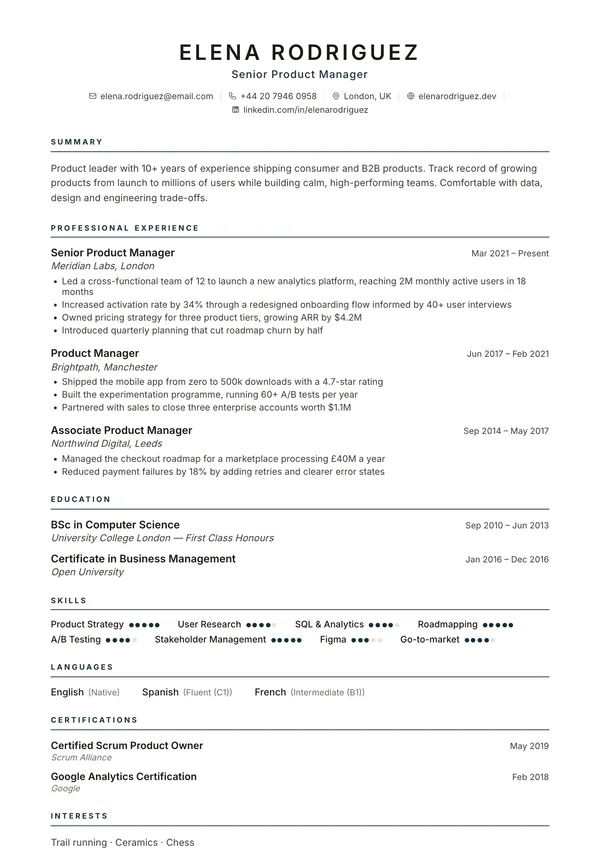
Atlas
Single column, no photo needed. A safe pick for UK and Irish employers.
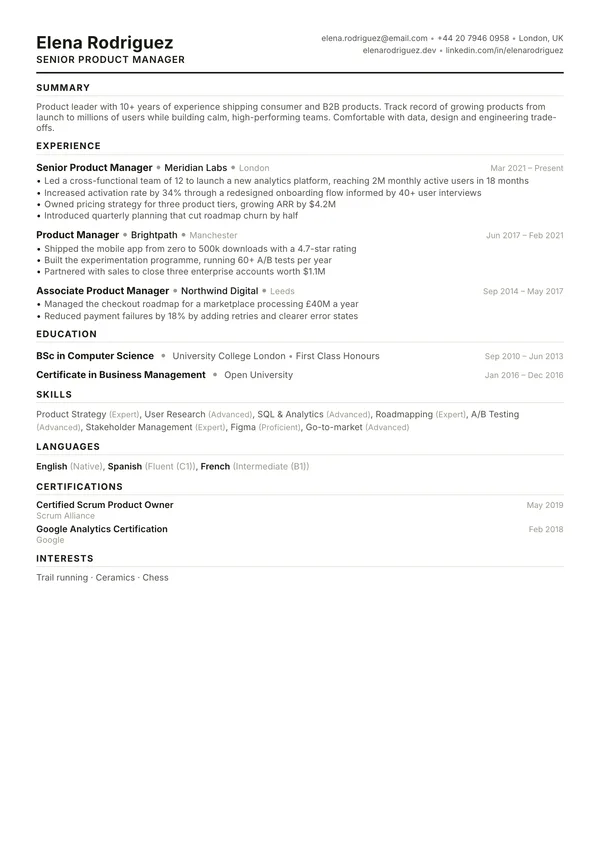
Summit
Dense, plain layout that keeps a long career on two pages.
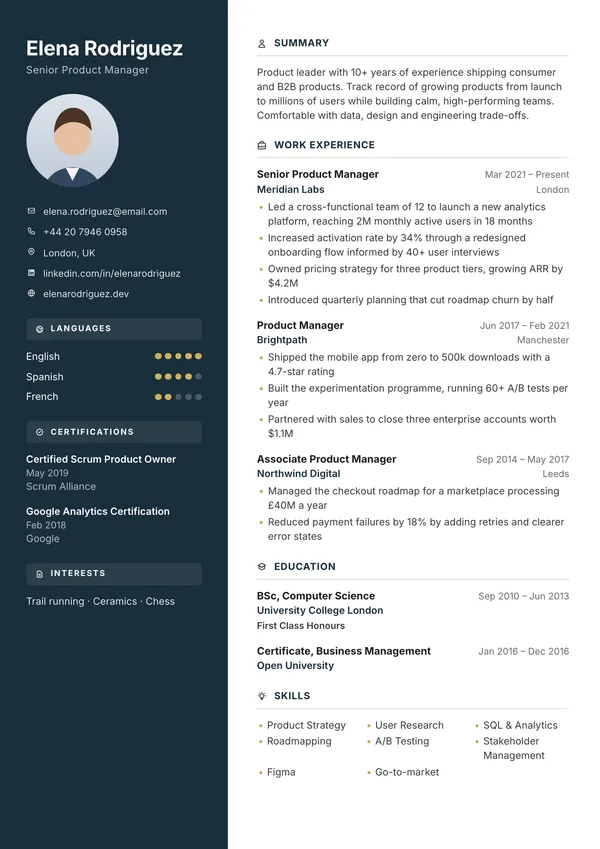
Bale
Sidebar with a round photo for markets where photos are normal.
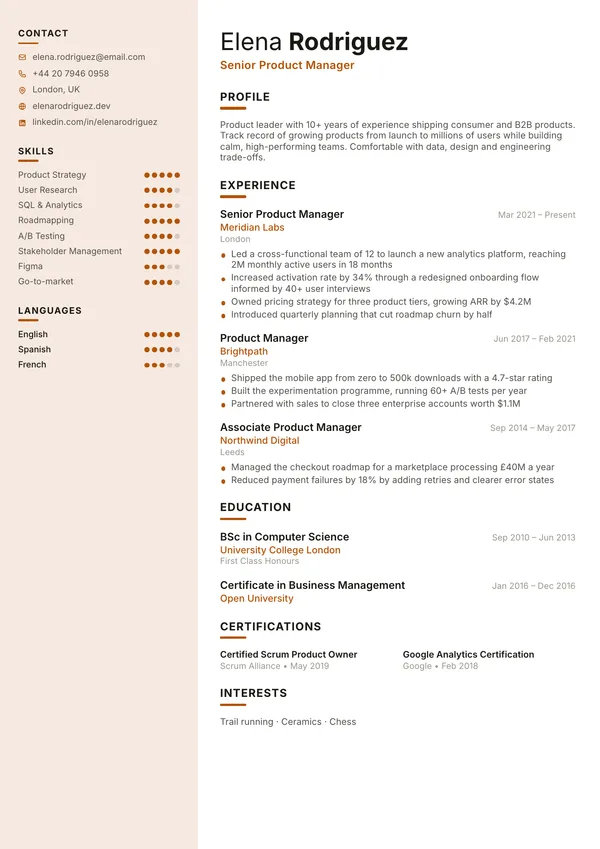
Terra
Two columns with space for personal details and languages.
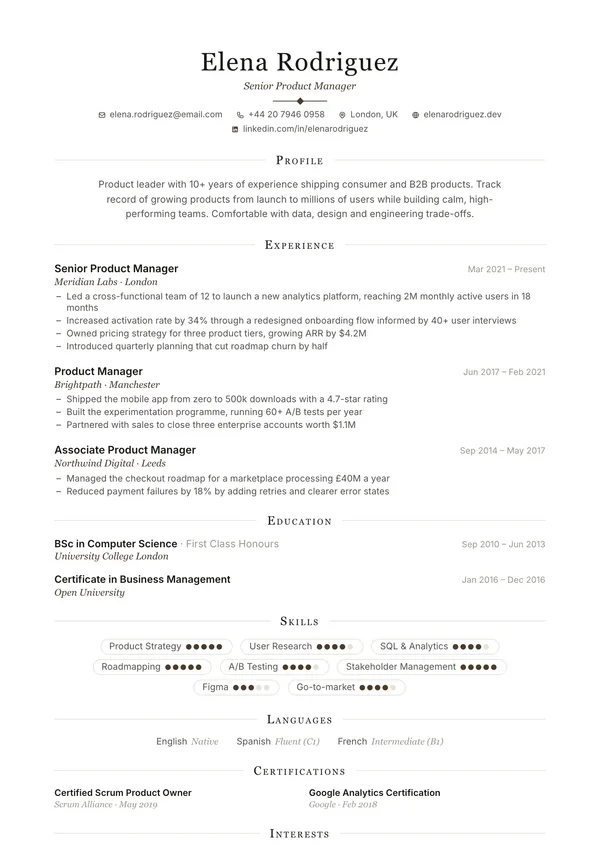
Quill
Serif design for academic, legal and public-sector CVs.
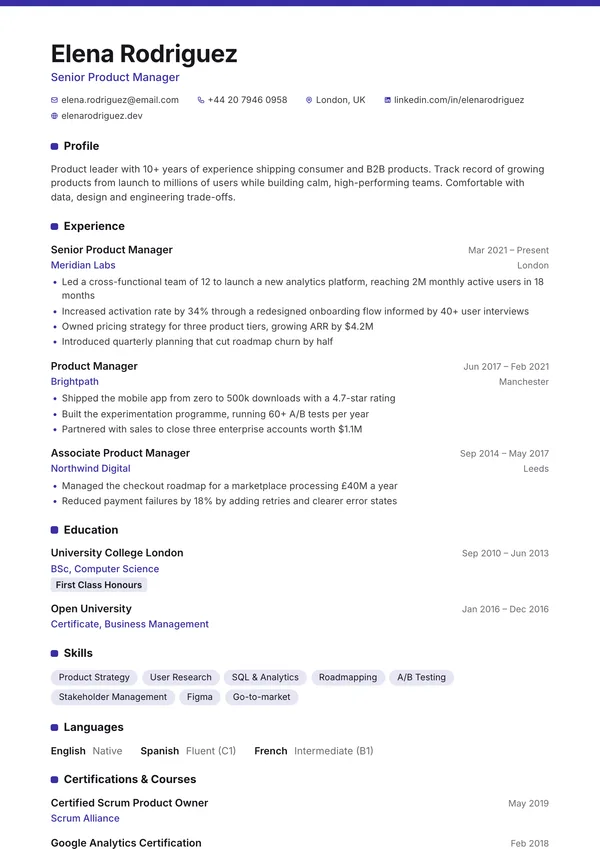
Campus
Education and projects first, for students and freshers.
Saving and sending your CV
Use a PDF
A PDF keeps your layout exactly as you designed it on every phone, laptop and printer. Text-based PDFs, like the ones CompleteCV produces, can be read by applicant tracking systems. Only send another format if the employer asks for it.
Name the file properly
Recruiters download dozens of files called "CV.pdf". Make yours easy to find: Firstname-Lastname-CV.pdf,
or Firstname-Lastname-CV-Data-Analyst.pdf if you are applying for different kinds of role.
Check it as the reader will see it
Open the PDF on your phone as well as your computer. Check that nothing has spilt onto an extra page, that links work, and that your phone number is correct. In the builder you can also run the free CV review in the Review tab for specific suggestions before you send it.
Quick checklist
- Reverse-chronological order (or education first if you are a fresher).
- One page for students, up to two A4 pages for most others.
- Name, phone, email and town at the top; no full address needed.
- Personal details and photo only where your target market expects them.
- Achievements, not duties, under each job.
- One clear font, 10 to 12 point body text, sensible margins.
- Saved as a PDF with your name in the file name.
Frequently asked questions
What is the best CV format?
For most people, a reverse-chronological CV: a short profile, then work experience with the most recent job first, then education and skills. It is what recruiters in the UK, Ireland, Europe, Africa and India expect, and it is easy for applicant tracking systems to read. Students and freshers can move education to the top.
How many pages should a CV be?
Two A4 pages is the usual maximum in the UK and Ireland, one page for students and recent graduates. In Nigeria, Ghana, Kenya and South Africa two to three pages is common for experienced candidates. Indian freshers usually keep to one page. Academic CVs can be longer.
What font and size should I use on a CV?
Use one clear font such as Calibri, Arial, Helvetica, Georgia or a similar modern sans-serif, at 10 to 12 points for body text and 14 to 18 points for your name. Keep margins between about 1.5 and 2.5 centimetres so the page does not look cramped.
Should I send my CV as a PDF or a Word file?
Send a PDF unless the employer asks for something else. A PDF looks the same on every screen and printer, and modern applicant tracking systems read text-based PDFs well. CompleteCV downloads your CV as a free PDF with selectable text.
Do I need to include my date of birth on my CV?
Not in the UK or Ireland, where employers generally avoid asking for age. Some employers in Africa, the Middle East and parts of Asia still request it. Add it only when the job ad or local custom expects it. This is general information, not legal advice.
What is the CV format for freshers?
A one-page CV with your contact details, a two- or three-line career objective, education with results, then academic projects, internships, skills and activities. Lead with what you have done, not with a long list of personal details.
What should I name my CV file?
Use your name and the document type, for example Amara-Okafor-CV.pdf. Add the job title if you are applying for several roles. Avoid names like CV-final-v3.pdf.
Keep going
- Free CV maker Make a CV for your country and download a free PDF.
- CV vs resume Which one to send, country by country.
- Europass CV When EU employers ask for the Europass format.
- Resume format Applying in the US or Canada? Start here.
- Free CV templates Preview every template full size.
- Open the CV builder Start building now, no sign-up needed to begin.